Ten Fire-Type Pokémon Cards Worth Looking At As Illustrations
A picture-first walk through ten Fire cards, chosen for how their artists handle heat, smoke, light and motion rather than for what they cost.

2026-09-18
Fire is the hardest type to illustrate well. Water gives an artist negative space and a cool ground to draw against; grass gives structure. Fire gives you a light source that eats its own outlines. Draw it badly and you get orange scribble. Draw it well and the whole card becomes a lighting problem: what the flame does to the Pokémon's underside, where the smoke sits, how much of the background you are allowed to lose.
So this is a list about that problem. Ten cards, ordered the way I would hang them, from the ones that treat fire as atmosphere to the ones that treat it as pure graphic energy. Some are the most expensive things in the type and some are not. Price is not the argument here and I have not ordered by it.
A note on names you will see repeatedly. Mitsuhiro Arita and Masakazu Fukuda are painters, and it shows in how they handle edges. 5ban Graphics, aky CG Works and PLANETA are studios working in 3D and digital compositing, which is a completely different craft — and worth judging on its own terms rather than against a brush.
10. Flareon ☆
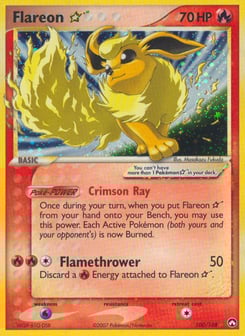
Flareon ☆
Power Keepers · #100/108 · Rare Holo Star
Illustrated by Masakazu Fukuda
$2,000.00
Fukuda is the best fire painter the TCG has had, and this is the clearest demonstration. Flareon's whole body is a fire problem — that collar and tail are meant to read as fur, but fur lit from inside. Fukuda solves it by keeping the silhouette soft and the value range tight: cream to amber to a deep rust in the shadow, with almost no black anywhere. The mane is painted in long directional strokes so it moves even though the pose is static.
The Holo Star treatment helps rather than fights the art, because the drawing underneath is already warm-toned all over. Look at where the light lands on the muzzle and the front leg. That is a painter deciding where the eye goes, not a filter deciding for him.
9. Torchic ☆
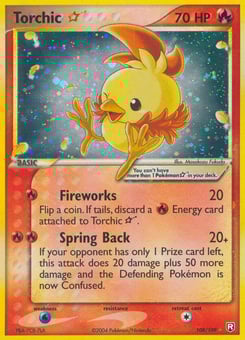
Torchic ☆
Team Rocket Returns · #108/109 · Rare Holo Star
Illustrated by Masakazu Fukuda
$1,200.00
The same hand, working small and working restrained. A Torchic gives you very little to burn — no mane, no tail flame — so Fukuda builds the whole composition out of the bird itself and a wash of warm ground. The result is one of the gentlest cards in the type: rounded forms, soft contact shadow, colour held mostly in the orange-to-peach range with that dab of grey-blue in the eye doing an enormous amount of work.
I like it as a counterweight to everything else here. Fire does not have to mean an explosion. This is heat as warmth, not heat as force, and it is the only card on the list where you could call the palette tender.
8. Shining Charizard
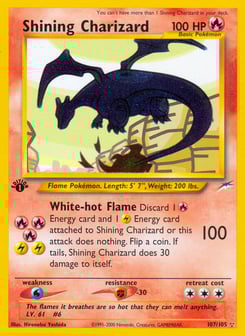
Shining Charizard
Neo Destiny · #107/105 · Rare Shining
Illustrated by Hironobu Yoshida
$3,998.99
Hironobu Yoshida's Charizard is oddly calm for a card that is famous. The pose is a three-quarter turn with the wings opened rather than beating, and the flame on the tail is small. What the Shining treatment does is recolour the whole animal into golds and pale greens, which means Yoshida had to make a Charizard legible without its usual orange. He does it with linework — the wing membranes and belly scutes are crisply drawn, so the shape holds even when the colour goes strange.
It is worth looking at as an exercise in taking the type's palette away from an artist and seeing what is left. Quite a lot, as it turns out.
7. Entei & Raikou LEGEND
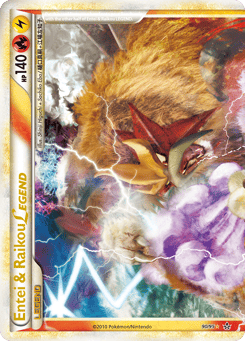
Entei & Raikou LEGEND
HS—Unleashed · #90/95 · LEGEND
Illustrated by Shinji Higuchi + Sachiko Eba
$315.98
The LEGEND cards are a format before they are illustrations: two halves, one image, joined across a physical seam. Shinji Higuchi and Sachiko Eba use that constraint properly here. The composition reads as a single landscape with two animals crossing it, and the smoke and cloud are arranged so the join falls in the busiest, least structural part of the picture.
The palette is the interesting bit. Entei's reds and Raikou's yellows should clash badly, and the fix is a lot of grey — storm cloud, dust, cold mid-tones — so the two hot colours have something neutral to sit against. It is the most cinematic thing in the type, which makes sense given Higuchi's other career, and it does something no single-panel card can: it makes you hold two cards to see one picture.
6. Charizard
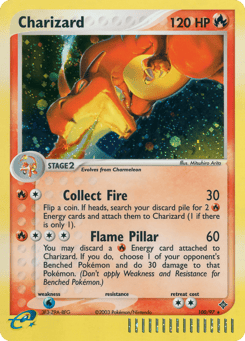
Charizard
Dragon · #100/97 · Rare Secret
Illustrated by Mitsuhiro Arita
$739.97
Arita's Dragon-era Charizard is the one I would put in front of someone who thinks he only ever drew the 1999 pose. The animal is foreshortened hard, coming down and toward you, and the flame is treated as a light source that spills onto the wing membranes from below. That underlighting is the whole card. It is also why the background is kept dark and simple — Arita needed somewhere for the light to fall off into.
His brushwork here is looser than in the Base Set days: more visible strokes in the smoke, softer edges on the wings, less inking. You can see a painter who has stopped illustrating a creature and started painting a moment.
5. Charmander
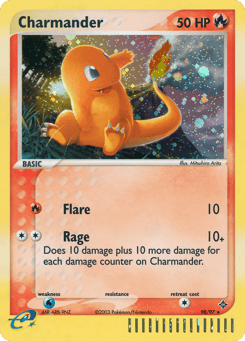
Charmander
Dragon · #98/97 · Rare Secret
Illustrated by Mitsuhiro Arita
$324.96
My argument for the small card. Arita paints the Charmander from slightly above and slightly behind the flame, so the tail fire is the nearest thing to the viewer and the body recedes behind it. That is a deliberate depth trick and it is unusual on a card this size — most Charmander art puts the body forward and the flame off to one side as decoration.
The palette is also warmer and dustier than the Charizard from the same set, closer to terracotta than orange. Held together with the Charmeleon, you get a set of three paintings with a shared light and a shared ground, which is a rarer thing in this hobby than it should be.
4. Moltres
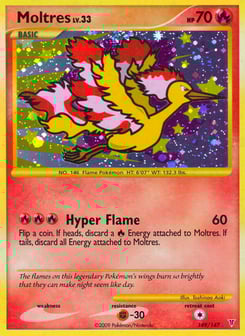
Moltres
Supreme Victors · #149/147 · Rare Secret
Illustrated by Toshinao Aoki
$352.24
Toshinao Aoki draws Moltres as a bird made of flame rather than a bird that is on fire, and the difference shows in the edges. Nothing on the wings has a hard contour; the plumes break up as they leave the body and get lost against the sky. That is the correct way to handle a Pokémon whose whole design is a flame shape, and a surprising number of artists do not risk it.
The upward diagonal of the pose gives the card its movement, and the background stays pale so the fire can be the darkest and the brightest thing at once. It is a graceful card in a type that mostly goes for force.
3. Ho-Oh LEGEND
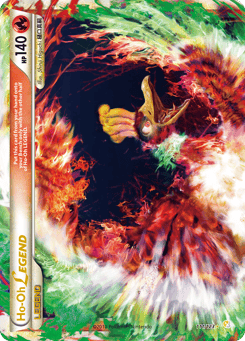
Ho-Oh LEGEND
HeartGold & SoulSilver · #111/123 · LEGEND
Illustrated by Shinji Higuchi
$228.50
Higuchi working alone this time, and it is a much more vertical, much more architectural picture than the Entei and Raikou pair. Ho-Oh is arranged so the wing span carries across the seam, which means the strongest line in the composition sits exactly where the two halves meet. It is a slightly reckless choice and it works because the feather rhythm is regular enough to survive the break.
The colour is gold over a pale, high sky — Ho-Oh is one of the few fire designs where the palette runs to gold and green rather than red, and Higuchi leans into that. It reads as light rather than heat.
2. Charizard ex
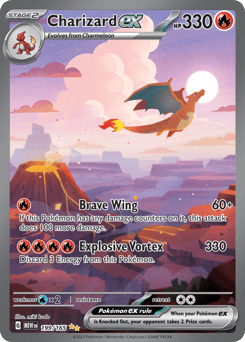
Charizard ex
151 · #199/165 · Special Illustration Rare
Illustrated by miki kudo
$365.47
miki kudo's Special Illustration Rare belongs to a different tradition to everything above it: illustration as scene-setting rather than creature portrait. The composition is deep, with the Charizard placed in an environment and the flame used to light that environment rather than to light the animal.
What I notice most is the restraint in the colour. Kudo keeps a lot of the frame in cool tones and lets a fairly small amount of orange do the work, which is the opposite of the studio approach of flooding the card with warmth. It makes the fire read as hot because it has something to be hot against.
1. Mega Charizard X ex
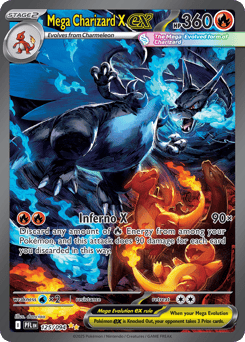
Mega Charizard X ex
Phantasmal Flames · #125/094 · Special Illustration Rare
Illustrated by danciao
$698.09
Ending on the newest hand here. danciao's Mega Charizard X is a blue-fire design, which inverts the whole type problem: the light source is cold, so the heat has to come from somewhere else — the pose, the smoke, the contrast against the darker ground.
The linework is sharper and more graphic than anything in the painted cards above, with hard highlights along the plates and a fairly aggressive silhouette. That is a stylistic choice rather than a shortcut, and it suits a Pokémon whose whole redesign is about being angular. Worth setting next to the Arita Charizard: two artists, same animal, completely different ideas about where a picture's energy lives.
Ten cards, and the through-line is not orange. It is what each artist decided to give up. Fukuda gives up hard edges. Aoki gives up outlines entirely. Higuchi and Eba give up having a single frame. Kudo gives up filling the card with warmth. Fire rewards subtraction more than any other type, and the cards that hold up are the ones where somebody knew what to leave out.
Prices shown are the market values recorded when this article was written on 2026-09-18. Each card page carries the current figure.