The Ten Best Yuka Morii Pokémon Cards
Ten of the best cards by the clay sculptor of the Pokémon TCG, chosen for what they do with form, light and texture rather than what they cost.

2026-09-15
Yuka Morii does not draw Pokémon. She makes them, out of clay, and then photographs them. That single fact explains almost everything about how her cards look and why they are unmistakable at a glance across a binder page.
Her body of work runs to 215 cards across 85 sets, from 2001 through to 2026, which makes her one of the longest-serving illustrators the game has. The combined value of that work is $3,546.22, and the expensive end of it is clustered in the e-Card era — though the price order and the interest order are not the same list, and this piece follows the second one.
What follows is ten cards chosen for what they are as objects: how she handles volume, where she puts the light, and which Pokémon turn out to want to be made of clay.
10. Swinub
Swinub
Skyridge · #107/144 · Common
Illustrated by Yuka Morii
$88.74
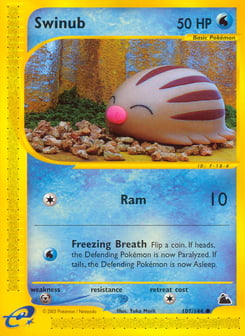
The pre-evolution is the better piece, and I will defend that. Piloswine gets the drama; Swinub gets the charm of an object you want to pick up. The body is a single rounded lump of clay with the fur worked in as texture rather than silhouette, so the whole figure keeps its blunt, pebble-like read from any distance. The pink snout is the only saturated note in the frame and Morii puts it dead centre.
This is also where you see her sense of scale. She tends to build small creatures small and shoot them close, with the ground crumbling into soft focus behind, so the card behaves like a macro photograph of something that exists. Very few illustrators in the card game make you think about the depth of field.
9. Ditto (Delta Species)
Ditto
Delta Species · #36/113 · Uncommon
Illustrated by Yuka Morii
$132.49
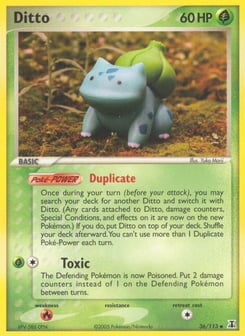
Delta Species gave Morii a brief no other illustrator has had: a run of Ditto cards, each one impersonating a different Pokémon, all in clay. It is the single most interesting thing in her body of work, because the joke and the medium are the same joke. Ditto is a creature made of malleable material pretending to be other creatures. So is a lump of clay.
What she does with it is subtler than it needed to be. Each imitation keeps Ditto's flat dot-eyes and its smug little mouth, and each one is slightly wrong in the way clay is wrong — a shape that has been pressed into an approximation rather than grown into one. The surfaces stay soft and thumbed. You can read the fingerprints as Ditto's own failure to commit to a form.
8. Ditto (Delta Species, 63/113)
Ditto
Delta Species · #63/113 · Common
Illustrated by Yuka Morii
$80.15
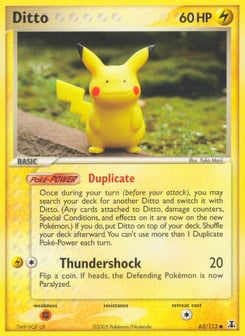
Worth singling out a second one to make the point that the set is a series and not a gag repeated eight times. Across the Delta Species Dittos the lighting setup stays consistent — same soft key, same neutral backdrop, same shallow depth — so the variable is purely the sculpt. That is a deliberate choice and a photographer's one. It turns the run into a set of studies rather than a set of illustrations.
If you collect Morii and only ever buy one thing, buy Dittos. If you collect Morii and want to understand her, buy several and lay them out next to each other.
7. Pikachu
Pikachu
Skyridge · #84/144 · Common
Illustrated by Yuka Morii
$180.89
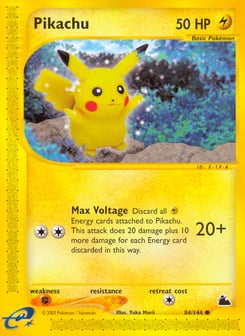
Pikachu in clay is a test, because the shape is so over-familiar that any deviation reads as error. Morii's version passes by leaning into softness. The cheeks are pressed rather than drawn, the tail has a slight sag where a flat illustration would give it a rigid zigzag, and the ears bend under their own weight. It looks like a toy that has been handled, which is exactly the right register for this particular Pokémon.
The Skyridge commons are where her style settles into what it would stay: warm neutral ground, one figure, no narrative clutter. She is not staging an action scene. She is presenting an object.
6. Blissey
Blissey
Neo Revelation · #2/64 · Rare Holo
Illustrated by Yuka Morii
$126.41
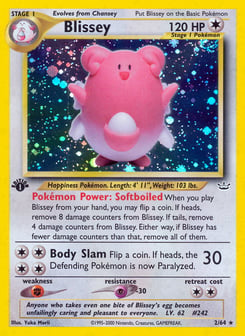
Her earliest work here, and it already looks like her. Blissey is almost entirely one colour, which for a sculptor is a gift — with no pattern to distract, all the information has to come from form and shadow, and the egg pouch, the shoulder curve and the little tuft of hair have to do everything. Morii shoots it from slightly below, which gives the figure a matronly bulk it does not have in other artists' hands.
The early cards have a rougher finish than the Skyridge run. Edges are less resolved, the backdrop is flatter. I like them for it. You can see the hand still deciding how clean it wants to be.
5. Jumpluff
Jumpluff
Aquapolis · #H13/H32 · Rare Holo
Illustrated by Yuka Morii
$109.82
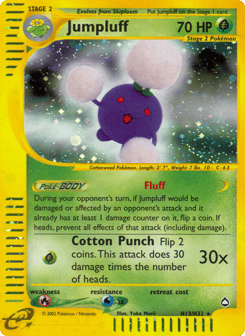
The hardest thing to do in clay is weightlessness, and Jumpluff is nothing but weightlessness. Morii solves it by making the cotton puffs enormous and slightly irregular — hand-rolled, not moulded — and by giving the body almost no visible support. It floats because the composition places it high in the frame with clear air beneath, not because anything in the sculpture is light.
She returns to the Hoppip line more than once, and the puffs are always the interesting part: a soft blue-green mass with texture worked right into the surface rather than painted on top.
4. Slowbro
Slowbro
FireRed & LeafGreen · #14/112 · Rare Holo
Illustrated by Yuka Morii
$69.51
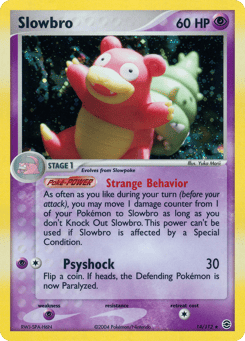
A comic sculpt, and knowingly so. Slowbro's whole design is a gag about a creature too dim to notice it is being bitten, and Morii stages it as a tableau — two separate sculpted bodies, one clamped to the other, with the Shellder given its own little expression. Because both objects are real, the physical absurdity of the arrangement is much funnier than it is in paint. It looks balanced. It looks like it would fall over.
The pinks here are worth a look too. She pitches Slowbro slightly dustier and greyer than the reference, which stops the figure going sickly under studio lighting.
3. Light Azumarill
Light Azumarill
Neo Destiny · #13/105 · Rare Holo
Illustrated by Yuka Morii
$33.58
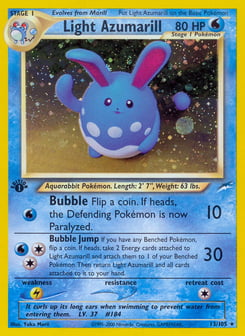
A small, strange one. Neo Destiny's Light cards asked for a brighter, gentler read of each Pokémon, and Morii's answer is a glossier clay surface with more reflected light in it than she normally allows. The result sits oddly against her usual matte, dusty finish — the figure looks faintly wet, which for a water Pokémon is either a clever solve or a happy accident. Either way it is one of the few times her material behaves like something other than earth.
2. Aipom
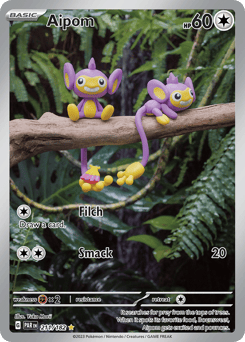
Aipom
Paradox Rift · #211/182 · Illustration Rare
Illustrated by Yuka Morii
$29.72
Two decades on and the modern Illustration Rare format suits her better than anything in between. The wide frame gives her room to build an actual environment rather than a backdrop, and Aipom — all limbs and that ridiculous hand-tail — is a sculpting problem she clearly enjoyed: every extremity needs an armature and a reason to be where it is. The tail does the composition's work, curling across the frame to lead your eye.
The late cards are cleaner than the early ones. More resolved edges, more considered set dressing, less visible thumbprint. Something is gained and something is lost, and this one is a good place to argue about which.
1. Klinklang
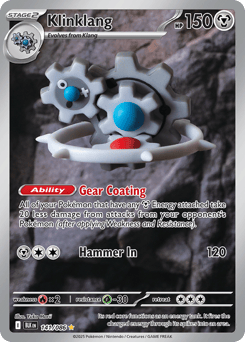
Klinklang
Black Bolt · #141/086 · Illustration Rare
Illustrated by Yuka Morii
$33.16
The oddest commission she has had. Klinklang is machined — interlocking gears, hard edges, industrial symmetry — and clay is the least machined material there is. Watching her build it anyway is the appeal: the teeth of the gears are individually formed, and the tiny imprecision in their spacing makes the thing look like folk craft rather than engineering.
It is a useful card for seeing the limits of her approach honestly. Some Pokémon want her hands and some resist them. She put it in the frame with a flat, cool light that emphasises the edges, which is the right call, and it still looks handmade. I think that is a virtue.
If there is a single thread through all of it, it is patience. Every one of these cards represents an object that was built, lit and shot, and the ones that work best are the ones where she trusted the material to be soft, dusty and slightly imperfect instead of fighting it. Twenty-five years in, that has not really changed.
Prices shown are the market values recorded when this article was written on 2026-09-15. Each card page carries the current figure.